
Cable Lengths Matter — Now You Can Model Them Precisely
Mar 19 2026
Authored by: Aasiya Sameen, Application Engineer
Engineers have always known that cable lengths influence EMC performance. That’s why Compliance-Scope has long included an intuitive cable configuration interface for quickly defining the standard test cables used in measurements—such as the 200 mm cables for CISPR-25 conducted emissions (CE) and the 2000 mm harness for CISPR-25 radiated emissions (RE) between the LISN or load box and the DUT.
But in many real-world designs, emissions are also strongly influenced by the cables connecting the DUT to its loads. These harnesses—often long, routed along complex paths, or even twisted—can significantly affect both conducted and radiated emissions, especially at higher frequencies.
With Compliance-Scope 5.0.0, you can now model these cables as well.
The new release introduces the ability to simulate regular and twisted cables along realistic paths, closely mirroring the physical wiring used in the laboratory setup. This makes it possible to capture harness-related EMC effects much earlier in the design cycle.
For example, consider a headlamp driver powering three headlamp boards, each connected to the DUT through long harnesses. As shown in the example below, the cable lengths can have a noticeable impact on emissions at higher frequencies. With the new cable modeling capability in Compliance-Scope 5.0.0, engineers can now predict and mitigate these effects before hardware testing, reducing surprises during compliance measurements.
In short: what used to be discovered in the lab can now be anticipated in simulation.
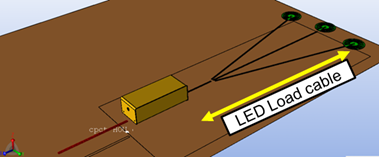
Figure: Load cable length varied from 25 cm to 95 cm
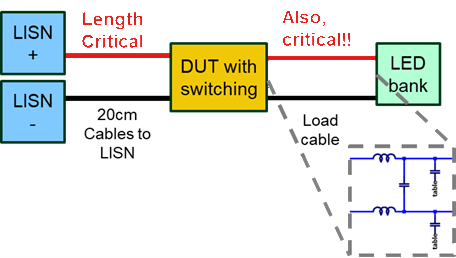
Figure: Schematic diagram of both LISN and load-side cable wrt DUT
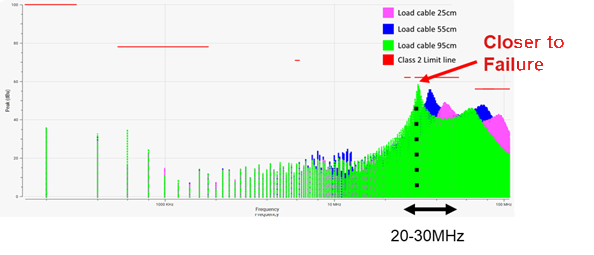
Figure: Impact of load cable length changes in CE results
© 2026 SimYog Technologies Pvt. Ltd. – All Rights Reserved.