
Improving “Low-Frequency” Robustness in EMC Simulation
Mar 19 2026
Authored by: Harikiran Muniganti, Co-Founder
For EMC simulation, low-frequency stability is not just an elegant mathematical theory – it is a practical requirement.
How low is “low-frequency”? Depends on the Design-Under-Test (DUT) dimension. When the structure size is smaller than a fraction (e.g. 25%) of the wavelength for the given frequency, “low-frequency” instability may occur. This phenomenon is common to all traditional 3D full-wave frequency-domain solvers like Method of Moments (MoM) or Finite Element Method (FEM).
Why should I care as an EMC simulation engineer? Many standards and real-world problems begin in the kHz-to-low-MHz range, and simulation must remain robust there to be useful.
With the Compliance Scope 5.0.0 release, an improved loop-tree decomposition scheme helps address the root cause of this low-frequency breakdown. Since efficient construction of global loops can become a bottleneck as mesh size increases, Compliance Scope 5.0.0 introduces efficient computation of global loops within the loop-tree decomposition flow. This enables stable and scalable low-frequency simulation, helping engineers obtain reliable results at all frequencies of interest.
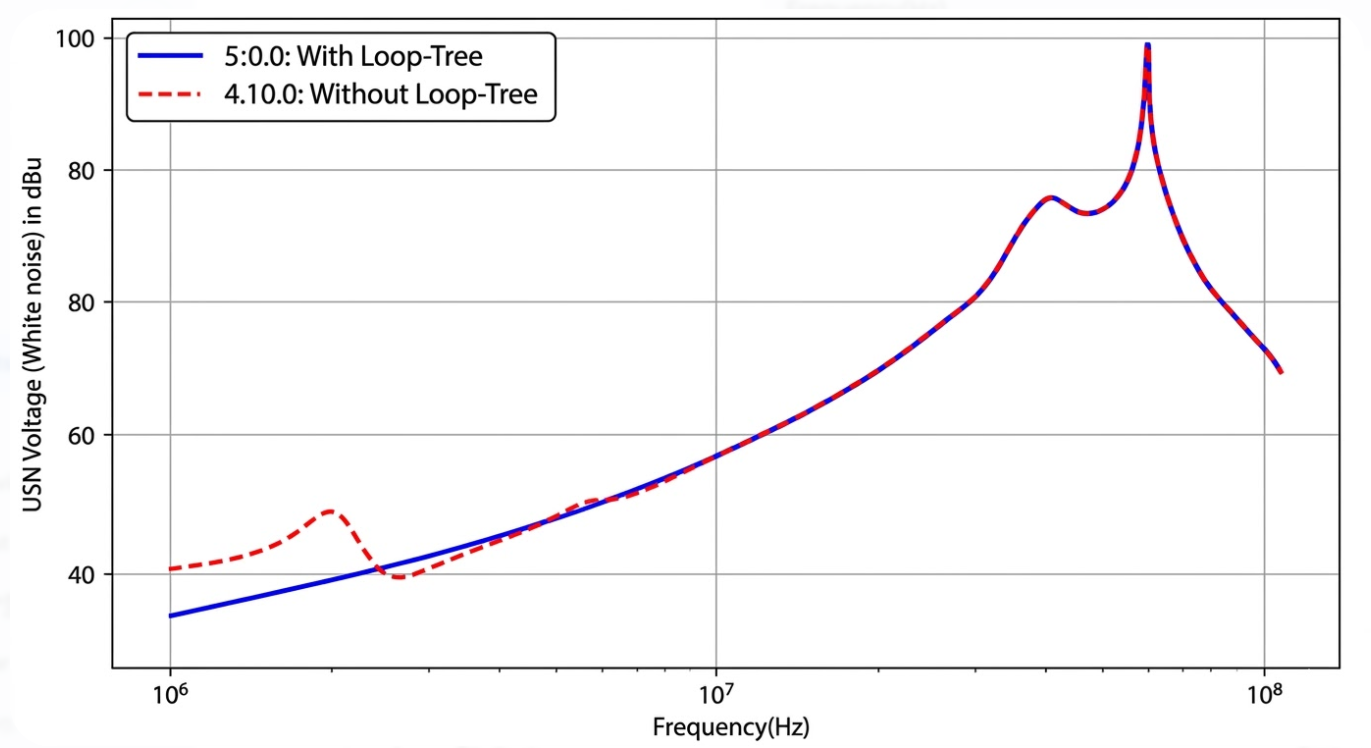
Figure: LISN voltage for a CISPR 25 conducted-emission voltage-method test case for unit-excitation
© 2026 SimYog Technologies Pvt. Ltd. – All Rights Reserved.